Sep 17, 2010

Healing Mysteries of the Rosary

On meditating upon the mysteries of the Rosary the other day, I noted that none of them deal with Jesus’ healing–despite the importance of healing in the Gospels. After some reflection, meditation and study, I’ve come up with a set that I thought might fill this void. Here are the  applicable scriptural references, a memorable passage and proposed fruit of each mystery:

~ ~ ~ ~ ~

First Healing Mystery: The Paralytic
(Luke 5:17-26; Mark 2:1-12)
Fruit of the Mystery: Forgiveness of Sins

the_power_of_jesus_to_forgive_sin

One day as Jesus was teaching, Pharisees and teachers of the law were sitting there who had come from every village of Galilee and Judea and Jerusalem, and the power of the Lord was with him for healing. And some men brought on a stretcher a man who was paralyzed; they were trying to bring him in and set (him) in his presence. But not finding a way to bring him in because of the crowd, they went up on the roof and lowered him on the stretcher through the tiles into the middle in front of Jesus.

When he saw their faith, he said, "As for you, your sins are forgiven." Then the scribes and Pharisees began to ask themselves, "Who is this who speaks blasphemies? Who but God alone can forgive sins?"

Jesus knew their thoughts and said to them in reply, "What are you thinking in your hearts? Which is easier, to say, 'Your sins are forgiven,' or to say, 'Rise and walk'? But that you may know that the Son of Man has authority on earth to forgive sins''--he said to the man who was paralyzed, "I say to you, rise, pick up your stretcher, and go home."

He stood up immediately before them, picked up what he had been lying on, and went home, glorifying God. Then astonishment seized them all and they glorified God, and, struck with awe, they said, "We have seen incredible things today."

But that you may know that the Son of man hath power on earth to forgive sins, (he saith to the sick of the palsy): I say to thee: Arise. 
 
~ ~ ~ ~ ~
Second Healing Mystery: The Centurion’s Servant
(Matthew 8:5-13; Luke 7:1-10)
Fruit of the Mystery: Submission to God’s will

centurians servant

When [Jesus] had finished all his words to the people, he entered Capernaum.  A centurion there had a slave who was ill and about to die, and he was valuable to him. When he heard about Jesus, he sent elders of the Jews to him, asking him to come and save the life of his slave. They approached Jesus and strongly urged him to come, saying, "He deserves to have you do this for him, for he loves our nation and he built the synagogue for us."

And Jesus went with them, but when he was only a short distance from the house, the centurion sent friends to tell him, "Lord, do not trouble yourself, for I am not worthy to have you enter under my roof. Therefore, I did not consider myself worthy to come to you; but say the word and let my servant be healed. For I too am a person subject to authority, with soldiers subject to me. And I say to one, 'Go,' and he goes; and to another, 'Come here,' and he comes; and to my slave, 'Do this,' and he does it."

When Jesus heard this he was amazed at him and, turning, said to the crowd following him, "I tell you, not even in Israel have I found such faith."

When the messengers returned to the house, they found the slave in good health.

Lord, I am not worthy that thou shouldst enter under my roof;
but only say the word, and my servant shall be healed.

~ ~ ~ ~ ~
Third Healing Mystery: The Woman with a Hemorrhage
(Luke 8:42b-48; Mark 5:24-34)
Fruit of the Mystery: Certainty

Paolo_Veronese_Christ_and_the_Woman_with_the_Issue_of_Blood_525

There was a woman afflicted with hemorrhages for twelve years. She had suffered greatly at the hands of many doctors and had spent all that she had. Yet she was not helped but only grew worse. She had heard about Jesus and came up behind him in the crowd and touched his cloak.

She said, "If I but touch his clothes, I shall be cured."

Immediately her flow of blood dried up. She felt in her body that she was healed of her affliction. Jesus, aware at once that power had gone out from him, turned around in the crowd and asked, "Who has touched my clothes?" But his disciples said to him, "You see how the crowd is pressing upon you, and yet you ask, 'Who touched me?'"

As he looked around to see who had done it the woman, realizing what had happened to her, approached in fear and trembling. She fell down before Jesus and told him the whole truth. He said to her, "Daughter, your faith has saved you. Go in peace and be cured of your affliction."

Daughter, thy faith hath made thee whole. Go thy way in peace

~ ~ ~ ~ ~


Fourth Healing Mystery: The Blind Beggar
(Luke 18: 35-43)
Fruit of the Mystery: Tenacity

blind beggar

Now as he approached Jericho a blind man was sitting by the roadside begging, and hearing a crowd going by, he inquired what was happening. They told him, "Jesus of Nazareth is passing by."

He shouted, "Jesus, Son of David, have pity on me!"

The people walking in front rebuked him, telling him to be silent, but he kept calling out all the more, "Son of David, have pity on me!"

Then Jesus stopped and ordered that he be brought to him; and when he came near, Jesus asked him, "What do you want me to do for you?

He replied, "Lord, please let me see."

Jesus told him, "Have sight; your faith has saved you."

He immediately received his sight and followed him, giving glory to God. When they saw this, all the people gave praise to God.
Son of David, have mercy on me!

~ ~ ~ ~ ~
Fifth Healing Mystery: The Raising of Lazarus
(John 11:1-45)
Fruit of the Mystery: Promise of Eternal Life

Alessandro_Magnasco's_painting_'The_Raising_of_Lazarus'

Jesus said to the disciples, "Lazarus has died. And I am glad for you that I was not there, that you may believe. Let us go to him." So Thomas, called Didymus, said to his fellow disciples, "Let us also go to die with him."

When Jesus arrived, he found that Lazarus had already been in the tomb for four days. Now Bethany was near Jerusalem, only about two miles away. And many of the Jews had come to Martha and Mary to comfort them about their brother. When Martha heard that Jesus was coming, she went to meet him; but Mary sat at home.

Martha said to Jesus, "Lord, if you had been here, my brother would not have died. (But) even now I know that whatever you ask of God, God will give you."

Jesus said to her, "Your brother will rise."

Martha said to him, "I know he will rise, in the resurrection on the last day."

Jesus told her, "I am the resurrection and the life; whoever believes in me, even if he dies, will live, and everyone who lives and believes in me will never die. Do you believe this?"

She said to him, "Yes, Lord. I have come to believe that you are the Messiah, the Son of God, the one who is coming into the world." When she had said this, she went and called her sister Mary secretly, saying, "The teacher is here and is asking for you."

As soon as she heard this, she rose quickly and went to him. For Jesus had not yet come into the village, but was still where Martha had met him. So when the Jews who were with her in the house comforting her saw Mary get up quickly and go out, they followed her, presuming that she was going to the tomb to weep there.
When Mary came to where Jesus was and saw him, she fell at his feet and said to him, "Lord, if you had been here, my brother would not have died."

When Jesus saw her weeping and the Jews who had come with her weeping, he became perturbed and deeply troubled,and said, "Where have you laid him?" They said to him, "Sir, come and see." And Jesus wept. So the Jews said, "See how he loved him." But some of them said, "Could not the one who opened the eyes of the blind man have done something so that this man would not have died?"

So Jesus, perturbed again, came to the tomb. It was a cave, and a stone lay across it. Jesus said, "Take away the stone."

Martha, the dead man's sister, said to him, "Lord, by now there will be a stench; he has been dead for four days."

Jesus said to her, "Did I not tell you that if you believe you will see the glory of God?"

So they took away the stone. And Jesus raised his eyes and said, "Father, I thank you for hearing me. I know that you always hear me; but because of the crowd here I have said this, that they may believe that you sent me." And when he had said this, he cried out in a loud voice, "Lazarus, come out!"

The dead man came out, tied hand and foot with burial bands, and his face was wrapped in a cloth. So Jesus said to them, "Untie him and let him go."

Now many of the Jews who had come to Mary and seen what he had done began to believe in him

Did not I say to thee that if thou believe, thou shalt see the glory of God?
**************************************

Sep 4, 2010

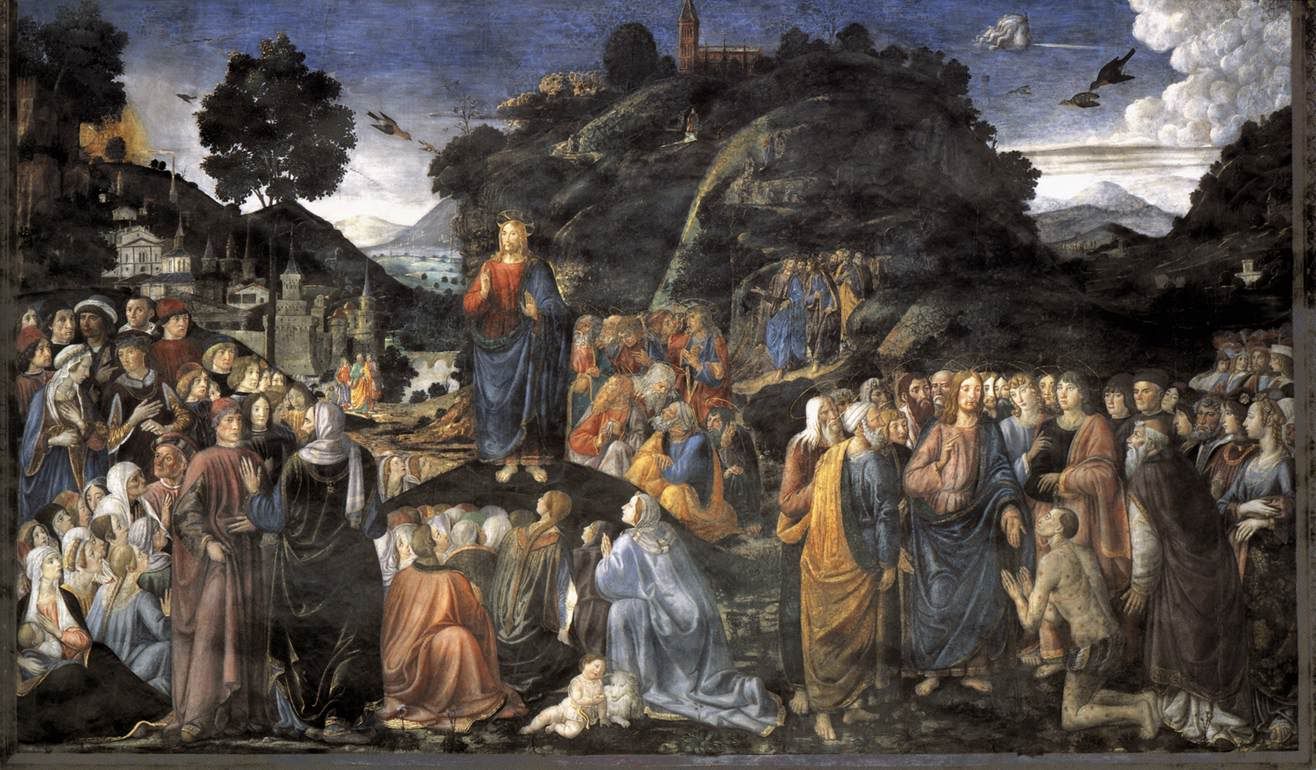
The Beatitudes


One of the best known Gospel reading is Matthew 5:1-12a.  The passage from Matthew marks the opening of the Sermon on the Mount, the first of Jesus' sermons in Matthew. This part of the Sermon on the Mount is known as the Beatitudes.  A beatitude is an exclamation of congratulations that recognizes an existing state of happiness. See The New Jerome Biblical Commentary, p.620.

The importance of the Beatitudes cannot be overlooked. Bishop Fulton Sheen, in Life of Christ, takes the position that no one can truly understand the Mount of Calvery without understanding the Mount of the Beatitudes:
He who climbed the first to preach the Beatitudes must necessarily climb the second to practice what He preached. The unthinking often say the Sermon on the Mount constitutes the "essence of Christianity." But let any man put these Beatitudes into practice in his own life, and he too will draw down upon himself the wrath of the world. The Sermon on the Mount cannot be separated from His Crucifixion, any more than day can be separated from night. The day Our Lord taught the Beatitudes, He signed His own death warrant. The sound of nails and hammers digging through human flesh were the echoes thrown back from the mountainsides where He told men how to be happy or blessed. Everybody wants to be happy; but His ways were the very opposite of the ways of the world. (p.114)
The Catholic Encyclopedia entry on the Beatitudes echoes this that:
the eight conditions [the Beatitudes] required constitute the fundamental law of the kingdom, the very pith and marrow of Christian perfection. For its depth and breadth of thought, and its practical bearing on Christian life, the passage may be put on a level with the Decalogue in the Old, and the Lord's Prayer in the New Testament, and it surpassed both in its poetical beauty of structure.
There are two versions of the Beatitudes in the New Testament. The reading from Matthew is:
When Jesus saw the crowds, he went up the mountain, and after he had sat down, his disciples came to him. He began to teach them, saying:

“Blessed are the poor in spirit, for theirs is the Kingdom of heaven.
Blessed are they who mourn, for they will be comforted.
Blessed are the meek, for they will inherit the land.
Blessed are they who hunger and thirst for righteousness,
for they will be satisfied.
Blessed are the merciful,  for they will be shown mercy.
Blessed are the clean of heart, for they will see God.
Blessed are the peacemakers, for they will be called children of God.
Blessed are they who are persecuted for the sake of righteousness, for theirs is the Kingdom of heaven.
Blessed are you when they insult you and persecute you
and utter every kind of evil against you falsely because of me.
Rejoice and be glad, for your reward will be great in heaven.”
The Beatitudes are also shown in Luke (6:22-26), although there is a reduction number of "blessings" and the contrast of what are known as the "four woes":
And raising his eyes toward his disciples he said:
"Blessed are you who are poor, for the kingdom of God is yours.
Blessed are you who are now hungry, for you will be satisfied. Blessed are you who are now weeping, for you will laugh.
Blessed are you when people hate you, and when they exclude and insult you, and denounce your name as evil on account of the Son of Man.Rejoice and leap for joy on that day! Behold, your reward will be great in heaven. For their ancestors treated the prophets in the same way.
But woe to you who are rich, for you have received your consolation.
But woe to you who are filled now, for you will be hungry.
Woe to you who laugh now, for you will grieve and weep.
Woe to you when all speak well of you, for their ancestors treated the false prophets in this way.
Many people have difficulty in understanding the first beatitude: Blessed are the poor in spirit, for theirs is the Kingdom of heaven. What exactly does that mean, to be poor in spirit?

As noted in the readings set forth above, the words in spirit are found in Matthew's version but not Luke's. The New Jerome Biblical Commentary make the following observation on this addition:
Matthew's editorial additions may be seen in several places. First he adds "justice" in vv 6 and 10, both as a formal divider and as one of the great themes of his Gospel. To "blessed are the poor" he adds "in spirit." The poor are the needy ones of Israel, ... who prefer the divine service to financial advantage. Their poverty is real and economic, but with a spiritual dimension. In Matt the addition of "in spirit" changes the emphasis from social-economic to personal-moral: humility, detachment from wealth, voluntary poverty. In the Bible economic destitution is an evil to be corrected (Deut 15:11), and wealth is not an evil in itself; indeed, it is a necessity for the well-being of the kingdom, but it risks neglect of God and of the poor. God's first priority is the care of the poor.
The other beatitude which often causes confusion is the second one,  Blessed are the meek, for they will inherit the land.  Confusion here arises because few people take the time to look up the meaning of the word "meek" and operate under the presumption that it means being a shy or reserved person. Instead, "meek" means to endure injury with patience and without resentment.

Aug 12, 2010

The Jesus Question

Prophets and holy men claim to speak for God. Jesus, on the other hand, claimed to be God. Was Jesus telling the truth or was he simply a madman?

There are numerous references in the Gospels to Jesus referring to himself as God. Here are a couple of obvious ones: 
  • "I and the Father are one." John 10:30
  •  
  • Jesus said of them, "If God were your Father, you would love me, for I proceeded and came forth from God; I came not of my own account, but he sent me. Why do you not understand what I say? It is because you cannot bear to hear my word." John 8:42-43

      I personally think that C.S. Lewis, in Mere Christianity, summed it up best:

      "I am trying here to prevent anyone saying the really foolish thing that people often say about Him: 'I'm ready to accept Jesus as a great moral teacher, but I don't accept His claim to be God.' That is the one thing we must not say. A man who was merely a man and said the sort of things Jesus said would not be a great moral teacher. He would either be a lunatic -- on the level with the man who says he is a poached egg -- or else he would be the Devil of Hell. You must make your choice. Either this man was, and is, the Son of God: or else a madman or something worse. You can shut Him up for a fool, you can spit at Him and kill Him as a demon; or you can fall at His feet and call Him Lord and God. But let us not come with any patronizing nonsense about His being a great human teacher. He has not left that open to us. He did not intend to." Mere Christianity, pages 40-41.

      There should be no real debate as to whether or not Jesus claimed to be God.

      The other part of the question, dealing with the role of Jesus as the Son of God, involves the doctrine of the Trinity. Christianity maintains that in the unity of the Godhead there are three separate and distinct Persons: the Father, the Son, and the Holy Spirit. Jesus himself states as much:

      And Jesus came and said to them, "All authority in heaven and on earth has been given to me. Go therefore and make disciples of all nations, baptizing them in the name of the Father and of the Son and of the Holy Spirit, teaching them to observe all that I have commanded you; and lo, I am with you always, to the close of the age." Matthew 28:18-20.

      There are numerous times in the Gospels where Jesus' words and actions demonstrate the distinct nature of the three persons. For example, when Jesus prays to God in the Garden of Gethsemane, ("My Father, if it be possible, let this cup pass from me; nevertheless, not as I will, but as thou wilt." Matthew 26:39) and when Jesus asks God to forgive during the crucifixion ("Father, forgive them; for they know no what they do." Luke 23:34). God the Father is clearly someone separate and distinct from Jesus the Son.

      The same is true with regard to the Holy Spirit. For example, Jesus speaks of the Holy Spirit on three occasions during the Last Supper discourse, indicating it is someone separate and distinct from himself and God the Father: 

      • "And I will pray the Father, and he will give you another Counsellor, to be with you for ever, even the Spirit of truth, whom the world cannot receive, because it neither sees him nor knows him; you know him, for he dwells with you, and will be in you." John 14:16-17. 
      •  
      • "The Advocate, the Holy Spirit that the Father will send in my name, he will teach you everything and remind you of all that I told you." John 14:26.
      •   
      • "But now I am going to him who sent me; yet none of you asks me, 'Where are you going?' But because I have said these things to you, sorrow has filled your hearts. Nevertheless I tell you the truth: it is to your advantage that I go away, for if I do not go away, the Counsellor will not come to you; but if I go, I will send him to you. And when he comes, he will convince the world of sin and of righteousness and of judgment: of sin, because they do not believe in me; of righteousness, because I go to the Father, and you will see me no more; of judgment, because the ruler of this world is judged. I have yet many things to say to you, but you cannot bear them now. When the Spirit of truth comes, he will guide you into all the truth; for he will not speak of his own authority, but whatever he hears he will speak, and he will declare to you the things that are to come. He will glorify me, for he will take what is mine and declare it to you. All that the Father has is mine; therefore I said that he will take what is mine and declare it to you." John 16:5-15.

            The question is not whether Jesus considered himself to be God. The question is whether or not you believe him.

            Aug 9, 2010

            Widows 1, Scribes nil

            tissot-the-widows-mite-745x485

            In the story of the widow's mite, Mk 12:38-44, Jesus provides us with an illustration of the type of people we should and should not imitate:
            In the course of his teaching Jesus said to the crowds, "Beware of the scribes, who like to go around in long robes and accept greetings in the marketplaces, seats of honor in synagogues,
            and places of honor at banquets. They devour the houses of widows and, as a pretext recite lengthy prayers. They will receive a very severe condemnation."
            He sat down opposite the treasury and observed how the crowd put money into the treasury.
            Many rich people put in large sums. A poor widow also came and put in two small coins worth a few cents.
             Calling his disciples to himself, he said to them,
            "Amen, I say to you, this poor widow put in more
            than all the other contributors to the treasury.
            For they have all contributed from their surplus wealth,
            but she, from her poverty, has contributed all she had,
            her whole livelihood." Mk 12:38-44
            According to the The New Jerome Biblical Commentary, p.622, the scribes were the interpreters of the Old Testament law, in other words the ancient Jewish version of lawyers.

            Scribes typically served as trustees of widows' estates. Their fee for such a service was a share of the funds in the estate.  So as to improve their chances of getting appointed to such a position (and thus devour the houses of widows), the scribes strove to improve their reputation of piety.  They would do this by wearing long robes designed to enhance their prestige and honor, seek out places of honor and publicly demonstrate their holiness . Jesus is warning against such behavior:

            Beware of the scribes, who like to go around in long robes and accept greetings in the marketplaces, seats of honor in synagogues, and places of honor at banquets. They devour the houses of widows and, as a pretext recite lengthy prayers.

            It should be noted that the scribes will receive a just reward for their actions.

            *      *     *
            The second part of the reading contrasts the conduct of the scribes with that of the widow. The two copper coins (lepta) were the smallest coins in circulation.  Jesus' observes that "this poor woman put in more than all the others contribution." He then goes on to explain that the widow made a real sacrifice to support the Temple, whereas the rich simply gave out of their surplus: For they have all contributed from their surplus wealth, but she, from her poverty, has contributed all she had, her whole livelihood. [bold added].

            The 19th Century Catholic mystic, Ven. Anne Catherine Emmerich, in her private revelation The Life of Jesus Christ and Biblical Revelations, gives further details as to what occurred in the Temple:
            In the center of the hall, or rather, nearer to the entrance,  stood the money box, an angular pillar, about half the height of a man, in which were three funnel-shaped openings to receive the money offerings, and at its foot was a little door. The box was covered with a red cloth over which hung a white transparent one. To the left was the seat for the priest who maintained order, and a table upon which could be laid doves and other objects brought as offerings. To the right and left of the entrance stood the seats for the women and the men, respectively. The rear of the hall was cut off by a grating, behind which the alter had been put up when Mary presented the Child Jesus in the Temple.

            Jesus today took the seat by the money box. It was an offering day for all that desired to purify themselves for the Paschal feast. The Pharisees, on coming later, were greatly put out at finding Jesus there, but they declined His offer to yield to them His place. The Apostles stood near Him, two and two. The men came first to the money box, then the women, and after making their offering, they went out by another door to the left. The crowd stood without awaiting their turn, only five being allowed to enter at a time. Jesus sat there three hours.

            Toward midday, as a general thing, the offerings ended, but Jesus remained much longer, to the discontent of the Pharisees. This was the hall in which He had acquitted the woman taken in adultery. The Temple was like three churches, one behind the other, each standing under an immense arch. In the first was the circular lecture hall. The place of offering in which Jesus was, lay to the right of this hall, a little toward the Sanctuary. A long corridor led to it. The last offering was made by a poor, timid widow. No one could see how much the offering was, but Jesus knew what she had given and He told His disciples that she had given more than all the rest, for she had put into the money box all that she had left to buy herself food for that day. He sent her word to wait for Him near the house of John Mark. The Life of Jesus Christ and Biblical Revelations, Vol. 4, pp. 28-30.
            The importance of the widow's offering cannot be underestimated.  In the Eastern rite of the Roman Catholic Church, for instance, it is mentioned in the Divine Liturgy of St. Mark, the ancient, traditional main Liturgy of the Orthodox Church of Alexandria. The widow's offering is on par with other great sacrifices made to God:
            As You accepted the sacrifice of our father Abraham, the incense of Zacharias, the alms of Cornelius, and the widow's two mites, accept also the thank-offerings of these, and give them for the things of time the things of eternity, and for the things of earth the things of heaven.
            St. John Chrysostom, one of the four Doctors of the Church coming from the  Eastern (Greek speaking) Roman empire,  reminded us why we ourselves need to imitate the widow in her sacrifice:
            For what is required is that we give, not much or little, but not less than is in our power. Think we on him with the five talents, and on him with the two.  Think we on her who cast in those two mites. Think we on the widow in Elijah's days. She who threw in those two mites said not, What harm if I keep the one mite for myself, and give the other? But gave her whole living. But you, in the midst of so great plenty, art morepenurious than she. Let us then not be careless of our own salvation, but apply ourselves to almsgiving. Homily 1 on Colossians

            Aug 1, 2010

            Something to do whilst waiting for a red light

            34632

            Our Lord told St. Gertrude the Great, that the following prayer would release 1,000 souls from Purgatory each time it is said:
            Eternal Father,
            I offer Thee the Most Precious Blood of Thy Divine Son, Jesus,
            in union with the Masses said throughout the world today,
            for all the Holy Souls in Purgatory,
            for sinners everywhere,
            for sinners in the Universal Church,
            those in my own home and within my family. Amen.

            Who was St. Gertrude the Great?
            250px-Gertrudis_Helfta

            Born in 1256, St. Gertrude died at age 46 on November 17, 1302. At the age of five she began to study at the convent, most likely because she had become an orphan. As she reached her early twenties, she began to be burned out on religious life and then she had a conversion.  Soon thereafter,  she began to have visions which lasted through the remaining years of her life.

            St. Gertrude was never formally canonized, but a liturgical office of prayer, readings, and hymns in her honor was approved by Rome in 1606. Pope Benedict XIV gave her the title "the Great" to distinguish her from another famous Catholic Gertrude (Abbess Gertrude of Hackeborn who was little Gertrude's teacher) and to recognize the depth of her spiritual and theological insight.

            The Life and Revelations of St. Gertrude can be found on the internet. While they do not contain the specific prayer set forth above, it appears to be a paraphrase of various passages and a common theme running through her writing:
            Nevertheless, as I gathered up all my strength to make a last effort to gain Thee by my loving caresses, I perceived that all this was of no avail, until I commenced praying for sinners, for the souls in Purgatory, or for those who were in any affliction, when I knew that I was heard; but still more one evening, when I formed the resolution of commencing the prayers which I say for the deceased offering them for those most beloved by Thee, with the Collect, Omnipotens, sempiterne Deus, cui nunquam sine spe, instead of commencing, as I had been accustomed to do, by praying for those related to me, with the Collect, Deus, qui nos patrem et matrem, and it seemed to me that this change was very pleasing to Thee. Book Two, Chapter 15.
            At the hour at which the Saint was to communicate was now near, she prayed God to show mercy to as many sinners as would be saved (for she dared not to pray for the reprobate) as He had that day delivered souls from Purgatory by the merit of the prayers which had been offered. But Our Lord reproved her timidity, saying: Is not the offering of My spotless Body and My precious Blood sufficient merit to recall even those who walk in the ways of perdition to a better life? Then Gertrude, reflecting on the infinite goodness testified by these words, exclaimed: "Since Thine ineffable charity will condescend to my unworthy prayers, I beseech Thee to deliver as many persons who live in sin and are in peril thereby as Thou hast delivered souls in Purgatory, without preferring those who are my friends with we by consanguinity or proximity". Our Lord accepted this petition graciously and certified its acceptance to her. "I would know further, I Lord," she continued, "what I shall add to these prayers to make them yet more efficacious?" Then, as she received no answer, she continued: "Lord. I fear that my unfaithfulness does not merit a reply to this question because Thou, who seest the hearts of all, knowest that I will not comply with Thy command." Then Our Lord, turning towards her with a countenance full of sweetness, replied: Confidence alone can easily obtain all things, but if your devotion urges you to add anything further, say the Psalm Laudate Dominum, omnes gentes three hundred and sixty-five times, in order to supply for those praises which men fail in offering Me. Book 3, Chapter 8.
            The Psalm Laudate Dominum is Psalm 117:
            Praise the Lord, all nations;
            Praise Him, all people.
            For He has bestowed
            His mercy upon us,
            And the truth of the Lord endures forever.
            Glory to the Father and to the Son and to the Holy Spirit,
            as it was in the beginning, is now, and forever,
            and for generations of generations.
            Amen.
            So, if your devotion urges you to do so, consider saying the prayer of St. Gertrude the Great and repeat the above Psalm 365 times.

            Jun 17, 2010

            Feeling Cold, pt. 2 - effect of insulin on body temp


            As you may recall, I recently started doing some data recording of my basal body temperature at waking and before bed. Through that data, it was pretty obvious that my core body temperature (CBT) is more than a bit lower than the normal 98.6 degrees (F). I have consistently run 96.5. Having established my initial baseline for my A-B-A data set test for my upcoming experiments on increasing my own CBT, I was doing some Google-research when I stumbled upon a preview of an article to be published this coming October in the medical journal, Diabetes.

            The article is entitled "Insulin Causes Hyperthermia by Direct Inhibition of Warm-Sensitive Neurons." The objective of the research was to examine the role of the metabolic signal insulin in the control of core body temperature. The findings demonstrated that insulin can directly modulate hypothalamic neurons that regulate thermogenesis and CBT which indicated that insulin plays an important role in coupling metabolism and thermoregulation at the level of anterior hypothalamus. Since I myself don't have a subscription to the Diabetes medical journal nor feel like spending $45 to read something I probably can't understand in the first place, I'll just assume they are correct until one of you readers points me to contrary medical research.

            According to a summary medical article on Medical News Today "New Link Discovered Between Core Body Temperature and Insulin," while much research has been conducted on insulin since its discovery in the 1920s, this is the first time the hormone has been connected to the fundamental process of temperature regulation:

            The scientists found that when insulin was injected directly into a specific area of the brain in rodents, core body temperature rose, metabolism increased, and brown adipose (fat) tissue was activated to release heat. The research team also found that these effects were dose-dependent - up to a point, the more insulin, the more these metabolic measures rose.

            "Scientists have known for many years that insulin is involved in glucose regulation in tissues outside the brain," said Scripps Research neurobiologist Manuel Sanchez-Alavez, who was first author of the new paper with Bartfai lab colleagues Iustin V. Tabarean and Olivia Osborn (now at the University of California, San Diego). "The connection to temperature regulation in the brain is new."

            ...

            In work coordinated by Osborn to characterize these neurons and their transcriptome (all of the messenger RNA molecules in a cell, which reflect the genes being expressed), the team noticed something unexpected - a messenger RNA for an insulin receptor.

            "We were surprised to find the insulin receptor," said Tabarean. "The insulin receptor is very well documented in the pancreas and in other peripheral tissues. But in the brain, it was not clear and we definitely did not know about its existence in warm-sensitive neurons."


            The article goes on to explain the methodology, then draws some conclusions:

            The authors note that while their new paper illuminates a key piece of the puzzle of the body's metabolic processes, it also raises many intriguing questions: How does insulin get to the brain's preoptic area - does it cross the blood-brain barrier or is it produced locally? Are diabetics, who are insensitive to insulin in peripheral tissues, still sensitive to insulin in the brain; if so, could this dichotomy be used in the development of a new therapy? Could scientists find a way to use these new insights to increase energy expenditure for the purpose of weight loss?

            Unlike the rodents in the medical tests, I'm not really in much of a position to stick a syringe into my brain and inject a bit of humalog to see what happens. So, I thought I'd ask for volunteers. Just kidding!

            It does, however, give me an idea for an experiment to try: determining the effect deprivation of all insulin from my system would have on my CBT. Given the above, would my CBT actually be lower if I had, say, 24 hours of no insulin whatsoever? It would be a pretty simple test to complete, perhaps at my next scheduled site change. Don't worry, I'd couple it with a complete fast as well so my blood sugar levels shouldn't rise too high... that in and of itself would be pretty interesting to know as well: what is the rising rate of one's blood sugar if nothing is ingested?

            As always, please don't try this at home. I don't mind screwing up my own body processes in the name of science, but I don't want to worry that I'm messing with your own. But, if you do decide to give it a try, don't hesitate to share the data!

            Jun 16, 2010

            Beware the Forgotten Bolus...


            On my iPod Diabetes Pilot app, my glucose readings are color-coded so I can immediately tell how I am doing. Black readings are in the desired range, blue are lows and reds are for those infernal highs. I was in the black all of yesterday (even with Mexican for lunch!) then ended the evening and early morning in the red. Why?

            I was a victim of the forgotten bolus.

            What is the forgotten bolus, you ask? Actually, if you ask that you probably aren't a diabetic. All real diabetics have experienced the forgotten bolus, when they get so caught up in the moment that they actually forget that they have diabetes and neglect to bolus.* Believe it or not, it actually sometimes happens. In my case it occurred at my daughter's birthday party at her favorite restaurant, Famous Dave's BBQ.

            Here's how I was attacked by the forgotten bolus. We sat down at the restaurant and I decided what to eat. I decided upon the BBQ pork sandwich, a diet Coke and some baked beans. I knew the baked beans were going to throw a complication into the mix, but I was ready for the challenge. I dutifully input all my info into my trusty little iPod app and it calculated the total to be 94 carbs. I input that into my pump and pushed the magic ACT button and it told me that I needed 13.4 units of insulin.

            Because of prior experience, I knew that sometimes the food took a bit longer than expected to arrive, so I refrained from giving myself the bolus at that time. Then she opened her birthday gifts and suddenly the food arrived, we hurried to clear the table and set about enjoying a nice meal, complete with a birthday sundae for the girl.

            Things went so well I didn't even notice that I had forgotten to bolus. A few hours later, about 8:30pm, I tested at a whopping 311! I figured that I had woefully underestimated the amount of BBQ sauce I had used--that or perhaps that diet Coke wasn't really a diet Coke--and gave myself the recommended 9.5 units of insulin. Two hours later: 345. 345? how could my blood sugar have gone up in two hours? Unless....

            That was when I checked and realized that I had become a victim of the forgotten bolus. The insulin units I gave myself at 10:30pm wasn't enough, which prompted another round at 2:40am (238, 5.9 units) until the morning arrived at a cool blue 70. A bit lower than I would have liked, but I wasn't going to complain and could certainly use the difference to offset twelve hours or so of being too high.

            Gee, if I'm already forgetting stuff at this age, what will I be like when I am really old? Like at, say, 50?!

            :-)


            * Not to be confused with the neglected bolus, which occurs when you know you really should bolus for something and you decline to do so out of laziness.

            Jun 15, 2010

            Letter to a New Diabetic: Leg Cramps

            Dear Concerned:

            I, too, have had the (un)pleasant experience of waking in the middle of the night mid-scream and in tears from the knotting pain of a cramp in the calf. Unfortunately, until you manage to get your blood glucose levels down to an acceptable level you will continue to be plagued by these nocturnal visitors.


            Assuming for discussion purposes that you haven't been intensely exercising, the most probably cause of your leg cramps are due to dehydration or an electrolyte imbalance. If you haven't noticed, one of the ways that your body rids itself of excess blood sugar is to try and pee it out. If you aren't careful to take more water in, you can easily find yourself dehydrated. This is known to accentuate muscle fatigue, which some people think can result in abnormal neural activity whereby certain muscles get the signal to contract but not relax.

            Another frequent cause of leg cramps is an imbalance in your electrolytes. Whether this is due to all the urination or caused by a lack of sufficient intake from the outset, the result is painful just the same. If you aren't regularly taking a multivitamin AND mineral supplement each day, you need to be. You should also have your physician order a complete blood work-up on you. That will tell you if you are deficient in calcium, potassium, magnesium,Vitamin D or other vital nutrients. (Note: unless you are farming and eating your own organic produce, have eggs from the chickens running around your backyard and raise and slaughter your own livestock, it's a safe bet that you aren't getting all the requisite nutrients you need from the food items you are purchasing from the grocery store.)

            However, none of this is of much solace at three in the morning when you are hopping around on one foot, trying not to wake everyone else up as you sob from the pain. Things to try include eating a banana (potassium) or chewing a couple of Tums (calcium). More general suggestions can be found in this article over at roadbikerider.com on cramps.

            Hope this helps,

            Niko

            Jun 13, 2010

            Static Electricity + Pump = Trouble


            I stumbled upon a nice blog (The Life of a Diabetic) which had an interesting post about attending to your diabetes when you are attending a conference. Well worth a read if you ever find yourself having to go on the road for a while. I added a few suggestions of my own, and while doing so recalled an event earlier this year which I thought I'd repost here.

            In short, I was at a conference about three hours away from home and inclement weather caused me to have to stay in a hotel rather than return home as originally planned. Due to the low temperature and bone dry air, the static electricity in the room was incredible. Sparks literally lit up the dark room every time I moved the sheets, myself, anything. Shortly thereafter, I noticed that my pump was dead. A brick. After much button mashing and trying to get it restarted I gave up and tried Minimed. I learned then that the static had fried the pump and despite some various techniques to restart it (e.g. remove the battery for a few hours), they sent me a replacement. Thank goodness for warranties.

            I hadn't given much thought to the effect of static electricity on insulin pumps, but it makes complete sense. I can remember when walking across a carpet in winter would be create enough static to erase the contents of a floppy disk. Sometimes when I get out of our minivan and close the door I get a small shock of static. From some of the google results I found, this appears to be a pretty common problem.

            In addition to weather, I've noticed a lot of static on the plastic slides at the playground where my kids play. The event has evidently been studied, but I couldn't figure out how to access the article to read it. Something you probably should be aware of if you are the parent of a kid with a pump.

            To freak yourself out more about static electricity, what it is and how to get rid of it (buy a humidifier!), check out this article on Static Electricity and People. I found it positively shocking!!

            (hehe, I couldn't resist such an electrifying opportunity! )

            Diabetic Datamining


            Being a diabetic athlete means a dedication to trial and error. Every diabetic athlete I have ever met or read about is a meticulous record-keeper and is in his or her own way a scientist, continuously experimenting on his or her body to find the best combination of insulin, food, stress, exercise. The crazy thing is that the combination keeps changing and it is highly personalized, so there has to be a willingness to continuously revamp, re-evaluate, re-organize. Having diabetes and being committed to performance requires a degree of mental flexibility that deserves recognition and celebration. It is symbolic of what all of us as humans have to do to perform at high levels.

            Mari Ruddy, from An Invitation to Ride


            I'd like to talk a bit about Diabetic Datamining. Diabetic Datamining is the art and science of

            Jun 12, 2010

            Feeling cold?

            The other day I stumbled upon an interesting article entitled "Chronic Fatigue Syndrome and Low Body Temperature" by Dr. David Jernigan of Hansa Center for Optimum Health. He is of the opinion that a low body temperature creates a "happy home for viruses and chronic infections, and is a sign of degeneration and gradual cellular death." As the body’s core temperature decreases all cellular energy also decreases thereby leading to profound and chronic fatigue that is not relieved by sleep. In his article he also summarizes the effect a cold body core temperature has on the circulation system, including peripheral circulation problems and cravings for high sugar based foods to increase the body's heat production. As you probably know, these are two issues every diabetic has to deal with on a daily basis.

            According to Dr. Jernigan, it is essential to monitor and graph your core body temperature upon awakening but before getting out of bed and sometime between 8 and 10 pm. Evidently the healthy body has daily temperature fluctuations (diurnal) with the coolest temperature upon awakening in the morning hours of 6-8 a.m. and the warmest being in the evening between 8-10 p.m. There should be a difference between the morning and evening temperature, in a healthy person, of at least 0.9° F (0.5° C).

            The core body temperature is the temperature taken under the tongue. After doing some research (okay, okay, after Googleing a bit) it appears that it is best to use a digital basal thermometer as they record much smaller temperature changes than an ordinary thermometer. As for the temperature you want to see, Dr. Jernigan maintains the optimal core body temperature is 98.6-99.6°F, with 98.6° F being the minimum.

            So, today as part of my continued life-logging project, I am off to purchase a basal thermometer. I've already gone online and purchased an iPod app for tracking blood temperature. I settled on BT Monitor.

            - - -
            6/13 Just a followup comment - my core morning temp turned out to be 96.5! That is more than 2 degrees colder than it is supposed to be. Hmm...

            Jun 4, 2010

            Random thought at 2:30 am

            When I was young, from as early as I can recall up to high school, I would often spend a Saturday night at my grandmother's house. Each night before bed she would give me a bowl of cereal "so I wouldn't feel hungry during the night." There was little chance of that actually happening since hunger and an Italian grandmother are two words seldom used in the same sentence, but it meant a lot to her and I certainly wasn't complaining. No doubt that is one of the reasons why I was always a bit overweight. Nothing like a bowl full of Frosted Flakes before bed.

            I was reminded of this at 2:30am this morning, as I write this entry. I just woke up with a low of 60 and decided I needed to treat it with more than some glucose tabs. So now I'm enjoying a bowl of Life cereal in the middle of the night. Why? At 11:30 pm I was at 68 and had taken 3 tabs and dropped my basal rate to 0.5 for an hour. But that evidently wasn't enough to bring my BG back up. It must have been those damn homemade coconut macaroons I had earlier in the evening; I must have over covered for them. Anyone have any idea how many carbs in a homemade chocolate covered coconut macaroon?!

            May 21, 2010

            Letter to a New Diabetic: Lowering Blood Sugar

            Dear Concerned:

            Welcome to the wonderful (and head scratching) world of blood sugar prediction. What works once may not work again the next time and what works for one person may not work for another. That's because reducing a high blood sugar is part science, part art and part luck.

            The science is in doing the calculations. If your blood sugar is 200 and you want to lower it to be at 100, you need to know how much 1 unit of insulin will reduce your blood sugar (value of "x"). Then just take 100 / "x" to get the number of units to take. This is a fairly simple algorithm that you and your Endo (diabetic doc) can determine by fasting and doing food/insulin tests. You probably have a "basic" rule for reduction but the more you can do to make it specific to you, the more accurate and hence the better.

            The art of treating a high blood sugar comes from knowing how YOUR body reacts to insulin, particularly when your blood sugar is at a higher level ( i.e., 1 unit = x reduction, but if the blood sugar is over 300, 1 unit only = 1/2 of x.) The only person that can take the time to figure that out is you. The other aspects that you have to consider include what you are doing at the time, e.g. exercising, moving, sleeping; how you are feeling at the time (as sometimes being sick = high blood sugar); and when and what you last ate and the amount of food still being digested in your system.

            As for the luck in lowering your blood sugar, well, there is a dash of that as well. Sometimes you do everything right and "by the book" and then look at the numbers, scratch your head and wonder if it was all just a waste of time. It's not, of course, but it can certainly be frustrating.

            Keep in touch,

            Niko

            May 19, 2010

            Letter to a New Diabetic: Your first low

            Dear Concerned:

            Sorry to hear what happened, but it was a good lesson to learn early. It's a real learning curve, isn't it?

            Two things caught my eye when I read your letter. First, you took insulin for a meal and then did not eat the meal. Second, you went for a walk without factoring in the affect it may have on your blood sugar level.

            The first one is a huge mistake. If you give yourself a shot insulin, you MUST eat the meal or take some carbs to cover for it because your blood sugar will drop. In my experience, meals are missed either voluntarily or involuntarily. The voluntarily misses can be prevented by simply making sure you eat as much as you bolused for, whether you are hungry or not! The involuntarily misses are much more difficult. For example, I usually do not bolus at a restaurant until the food is at my table. I've had too many situations arise where I give myself insulin for my meal and then the food doesn't arrive for whatever reason. I've also had the situation arise where I became sick after the bolus but before I could eat.

            The second issue is that you went for a walk. While perhaps not medically accurate, practically speaking exercise often increases the effectiveness of the insulin. So before you exercise, you need to check your blood sugar and either have it a bit higher, or have your meter and some carbohydrates with you as you work out/walk/run, whatever. It's a real pain in the ass, to be frank, but you do have to exercise. I've done some experience where instead of using insulin, I've used exercise to keep my blood sugar down. If you try it be sure to track your data and carry something to eat, such as the glucose tabs. For me, even something as common as mowing the lawn will cause me to get low, so I'll either eat before or keep an eye on my sugar level. A lot of people like the small boxes of Juicy Juice which are 15 carbs for those sudden lows. They are cheap and you can keep one or two in the car and drink them even when they are warm. Mmm, hot juice!

            Hope this helps,

            Niko

            May 17, 2010

            Letter to a new Diabetic: Welcome to the Club


            Dear Concerned:

            Good to hear from you but sorry it had to be under these circumstances. No doubt your head is spinning from your recent diagnosis and this is last thing you want to have to deal with. I'll not belittle the medical issues but, frankly speaking, have no doubt that you will do fine. Diabetes is a completely self-managed condition and if you pay attention to it you'll not be precluded from doing anything. There are type 1's (insulin dependent diabetics) who are in the Olympics, climb Everest, etc. I've traveled literally all over the world and have never had any issues. Some advance planning, yes, is needed. But nothing that you can't handle.

            I can remember when I was diagnosed back in '99. It was a real surprise because I didn't know anything about diabetes nor even what a pancreas did. Mine, like yours, just burned out and quit making the hormone insulin. Like you, I had no family history and no one I knew who could answer my many questions--once I had enough information to even begin to formulate them. If you haven't already done so, you should find yourself a good Endocrinologist and Certified Diabetic Educator (CDE).

            The first goal you and your doctor will work on will be to get your current blood sugars lowered from their high levels. There are two "numbers" you will soon learn are important: your at-the-moment blood sugar reading from your meter and an over-three-month reading (called your HbA1C) which gives you an average of the three months blood sugar levels. The aim of the diabetic management "game" is to get your HbA1C down to a normal level, i.e. something ideally in the 5 to 6 range. Mine was 14 or 15 when I was diagnosed. Yours is likely pretty high right now as well. The two weeks or so it will take to lower your blood sugar will, frankly, suck because your body had become used to the high levels so don't be surprised if you are irritable, tired, have headaches and the like.

            There are essentially two types of insulin families: the first is for "basal" rates, that is to say a sufficient amount of insulin to keep your blood sugar level over a long period of time. The second is for a "bolus" or giving yourself an injection of insulin before you eat or to lower your blood sugar. Ideally, you want the basal amount to always remain steady so if you don't eat your blood sugar remains the same (say, 100). Then before you eat something, say a cookie, you give yourself a shot of enough insulin (a bolus) to balance out the increase caused by the carbohydrates in the cookie. Simple. ;-)

            The days of "two shots only, one in morning one at night" pretty went out the window 15 years ago. My suggestion is that you immediately ask to get into multiple daily injection (MDI) therapy. If your current doctor doesn't know what that is then get another doctor. Essentially, that allows you to replicating a pancreas by giving yourself some shots of a basal rate insulin and separate shots of insulin before you eat to cover the carbs.

            Oh, yes, carbs. They are every diabetic's craving and aversion. As you probably know, everything you eat is made of three things: fat, protein, or carbohydrates. The first two don't have much of an affect on blood sugar (although fat can cause change in the rate the body uses the carbs). Carbs, on the other hand, get turned into glucose, which is the form of sugar your body runs on. So before you eat a food, you just have to look up the amount of carbs in the food to figure out how much insulin you have to inject to "cover" the carbs and return your blood glucose level to what it was before you ate.

            The other think you need to be aware of is a "low" blood sugar, called "hypoglycemia." That is what happens when you either take too much insulin or do something (such as exercise) which causes the body to use the insulin more effectively. If you do, you'll need to eat something to raise your blood sugar. I'd suggest you get some glucose tabs for the car and some Juicy Juice boxes or the like to keep on hand for when you go low, which you inevitably will.

            The last thing to remember is that if you don't test your blood sugar, you don't know what the number is. Sometimes it is high and you feel one way, the next time you feel that way it is low. Check your blood sugar often.

            Drop me a line if you have any more questions. Oh, and welcome to the club!

            Niko

            May 16, 2010

            Dream a little


            The challenge;

            Sunday 5/16 - Dream a little dream - life after a cure. To wrap up Diabetes Blog Week, let’s pretend a cure has been found. We are all given a tiny little pill to swallow and *poof* our pancreases are back in working order. No side effects. No more insulin resistance. No more diabetes. Tell us what your life is now like. Or take us through your first day celebrating life without the Big D. Blog about how you imagine you would feel if you no longer were a Person With Diabetes.

            For a while I would feel as if a part of me was missing. That would be my insulin pump. It's been attached to me for more than a decade now, 24 hours a day, 7 days a week. To not have it with me, clipped on my belt, would be... lonely.

            I'd also miss carrying my man-purse everywhere since I wouldn't need my meter. Where would I carry my iPod?

            But at the same time, I'd certainly LOVE not having to do all the fingersticks, infusion set insertions, math games, paying lots of $$$ each month for the medical supplies... I'd also enjoy the chance to be free to do anything, anywhere, anytime without having to worry about everything.

            May 14, 2010

            Let's get moving

            The challenge:
            Friday 5/14 - Let's get moving. Exercise . . . love it or hate it? Do you have a regular exercise routine? Or do you have trouble finding your exercise motivation? How do you manage your insulin and food to avoid bottoming out during your workout? Today is the day to tell us all about your exercise habits, or lack thereof.

            A true story:

            A few years back I underwent a treadmill stress test. It was one of the big ones, EKG patches and leads all over my body, oxygen regulator on my face, the whole nine years. I got on the treadmill and started walking along, completed the workout and waited for my doctor to view my results.

            After a few minutes he came in and started looking at the chart. "This is amazing!" he remarked. He flipped through the numbers, looked at the squiggles on the EKG ribbon tape for a moment, then called over the nurse. "Come take a look at this," he remarked to her. "This is unbelievable."

            I have to admit that I was a bit surprised, particularly given that I haven't really exercised much over the years. Or at all, my wife would tell you. Still, I must have done okay given the reaction.

            The doctor and the nurse peered at the results, then looked up me. "I've never seen anything like this," he told me. "You are amazingly out of shape." He looked down at my body. "It's funny, you don't look out of shape. But I'll be damned if you aren't the most out of shape person I have ever seen in my career!"

            Given that, perhaps you can understand my dislike of exercise. Oh, I know that some of you are thinking, "Heck, if the doctor told me that, I'd be exercising everyday!" My response? Yeah, sure you would. If you were that kind of person you probably wouldn't be sitting here, reading these words on your computer. You'd be out running a marathon or training for your next bike race or something. For me, exercise sucks. It's boring, my legs start hurting in about 5 minutes on the treadmill, I get dizzy, then I have to factor in the blood sugar issues... it's just too much of a pain.

            But I do to get on the treadmill at least twice a week for 30 minutes. It's a start. I would truly love to be in amazing shape like those men and women in the PX-90 infomercials. Of course, that's the one I watch where I think I'd just like to look like the "before" picture, let alone the "after." I then wonder what kind of problems you must have with infusion sets if you only have like 7% body fat (compared with my 27% or whatever it is.) I don't think I have to worry about those issues for quite a while... if ever.

            May 13, 2010

            To carb or not to carb?

            The challenge question:

            Thursday 5/13 - To carb or not to carb. Today let’s blog about what we eat. And perhaps what we don’t eat. Some believe a low carb diet is important in diabetes management, while others believe carbs are fine as long as they are counted and bolused for. Which side of the fence do you fall on? What kind of things do you eat for meals and snacks? What foods do you deem bolus-worthy? What other foodie wisdom would you like to share?

            I suppose I fall in the middle. Carbohydrates are certainly something to be limited if you wish to reduce the amount of insulin you inject. I've followed the low-carb way of eating off and on and I do have a lot of energy when I am eating low carb. It's expensive, though, and I usually end up freaking out and eating carbs after a week or so. More often, I just eat what I want and bolus to cover it. Life is too short.

            That being said, I do have some simple rules:

            (1) I can eat what I want, as long as I record it in my food diary and make the effort to look up the carbs.

            (2) If I am going to drink soda (and I have a love/hate relationship with it for various reasons), it has to be diet.

            (3) Whenever possible, eat food and not foodstuff. You know the difference. If it comes in a box, sits on a shelf or contains any ingredients you can't realistically find in your kitchen, it ain't food.


            The final foodie wisdom I will share with you non-existent readers (yes, I'm talking about... you!), is to read and listen to author Michael Pollan. He does an excellent job of explaining food and agricultural issues and is practical (and realistic). I've read almost all of his books and would highly recommend them.

            Because of him, we (a) have belonged to a CSA - community sustained agriculture - in which we support a local farmer and her family by buying all of our needed produce and eggs (fertilized AND really cage free!) from her; (b) haven't purchased bread in over two years because we make all of it ourselves in a whopping 5 minutes or so of work per day; and (c) make such "oddities" as our own, homemade corned beef, soups, etc.

            May 12, 2010

            My Biggest Supporter

            The challenge:

            Wednesday 5/12 – Your Biggest Supporter. Sure, our diabetes care is ultimately up to us and us alone. But it’s important to have someone around to encourage you, cheer you, and even help you when you need it. Today it’s time to gush and brag about your biggest supporter. Is it your spouse or significant other? Your best friend, sibling, parent or child? Maybe it’s your endo or a great CDE? Or perhaps it’s another member of the D-OC who is always there for you? Go ahead, tell them just how much they mean to you!


            I've been reflecting upon this question for some time and have come to the realization that I don't have such a person in my life. While my spouse does her best to point out I need to keep better control of my blood sugar (usually when she finds mold growing in the toilet), she has her hands full enough with our three kids to be spending her time understanding and dealing with diabetic issues. I tried to show her how the infusions sets work and how to turn off my pump, but it didn't really take. As for math calculations when figuring out blood sugar and insulin issues, forget it.

            I like my CDE since she is a type-1, much harder to bs your way through a meeting when the person you are talking with also has to stick her finger and wears a pump. She does her best but I'm probably not the easiest patient to deal with. Besides, I know what to do, I just have a problem with doing it.

            I only know one person that wears a pump and he is more out-of-control than I, so not much of a good influence there.

            So I'll plod on, figuring out things on my own and finding a helpful hint or two on the internet. Probably not the challenge response that you anticipated, eh?

            May 11, 2010

            Making the low go

            Tuesday 5/11 – Making the low go. Tell us about your favorite way to treat a low. Juice? Glucose tabs? Secret candy stash? What’s your favorite thing to indulge in when you are low? What do you find brings your blood sugar up fast without spiking it too high?

            Every diabetic has had to deal with a low blood sugar having no idea as to how much lower it will go before it levels out and/or begins to rise. When this happens to me, I treat using one of the following:

            The best: glucose tabs. Essentially 4 grams of pure energy. They are so sickly-sweet it's hard to really overeat them.

            A good alternative: a small can of orange pop. I've found this works pretty well because (a) there is only half a can, (b) it is drinkable, which is nice when chewing becomes an issue, and (c) you can drink it when it is warm and it doesn't taste bad.

            The common: one of the problems I have with just glucose tabs is that they bring you up but there is nothing of substance there. In those cases (read: 2:30 am) I sometimes opt for a bowl of cereal and rice milk. 1 cup of each does the job. The trick is to stop eating after one cup. Better said than done, particularly when you a bit "out of sorts."

            And now a quick story of a diabetic nightmare:

            It was a large slice of chocolate birthday cake covered in frosting. Ever diligent, I computed the amount of carbs necessary to cover and gave myself the bolus. About the time my insulin pump beeped that it had injected all of the requisite insulin my stomach decided that it didn't want any cake. In fact, it didn't want anything inside it and caused me to run to the toilet and throw up.

            So now I had absolutely nothing in my stomach and enough insulin coursing through my bloodstream to cause a serious medical situation. I grabbed a Coke from the refrigerator and did my best to chug it down, then threw it up, chugged more down, threw it up. It was awful. Adding to the problem is that due to its carbonation, it is pretty hard to chug large amounts of Coke. It is also sickly sweet, nauseatingly sweet.

            I was eventually able to get enough sugar into my system to balance out the insulin, but the experience haunted me for a long time. I stopped bolusing before meals and would wait until after I had eaten. I've gotten over that, but still I rarely bolus until the food I've ordered has been delivered.